
ASTANA — President Kassym-Jomart Tokayev and Russian President Vladimir Putin met ahead of the XXII Kazakhstan-Russia Interregional Cooperation Forum, focused on transport, logistics and regional economic ties, in Omsk on July 25. Their talks broadened the agenda beyond the forum’s economic focus to include the war in Ukraine, strategic partnership and cooperation on Kazakhstan’s first nuclear power plant.
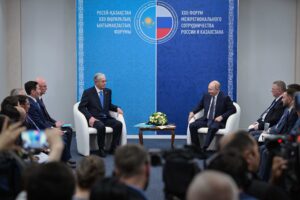
President Kassym-Jomart Tokayev and Russian President Vladimir Putin during the meeting in Omsk on July 25. Photo credit: Akorda.
During the meeting, Tokayev outlined his position on prospects for resolving the conflict between Russia and Ukraine. He said that from the very beginning he saw it as an interstate conflict. He also noted that “the nature of this conflict is not fully understood by many, including ourselves.” While acknowledging that neither side currently has a clear path toward resolving the conflict, Tokayev suggested that freezing the conflict could create conditions for renewed negotiations.
“Perhaps it is time to freeze this conflict and return to the Istanbul Formula 2.0, because significant results were achieved there. Then, under guarantees from the great powers, including Russia, we could move toward the long-awaited peace,” he said.
Tokayev also ruled out any role for Kazakhstan as a mediator, saying Russia is “a great country” that is capable of resolving the conflict on its own without outside mediation. He added that he had decided to voice his opinion publicly because many people knew about his planned visit to Omsk and the meeting with Putin.
“There is an opportunity to freeze the conflict. This is a well-established mechanism in international practice,” he added.
Tokayev also expressed concern over the continued loss of life, saying the conflict should be stopped because young people from both Russia and Ukraine continue to die.
“All of this must be stopped because, in my firm conviction, what is happening serves the interests of and brings satisfaction to the opponents of both Russia and the Ukrainian state,” he said.
Tokayev also reaffirmed Kazakhstan’s commitment to its strategic partnership and allied relations with Russia during the meeting.
“As for Kazakhstan’s position toward Russia, have no doubt: we have always regarded, and continue to regard, Russia as a great state. We remain committed to strategic cooperation with Russia and allied relations, no matter how difficult the circumstances may be. Today’s forum is further confirmation of that,” he said.
President Tokayev also noted progress in implementing the joint project to build Kazakhstan’s first nuclear power plant. He shared that he has been informed that field work at the site near Lake Balkhash is nearing completion
“This project is not only about producing a new type of energy in Kazakhstan. It is a project that will bring our countries and, most importantly, our peoples closer together, particularly the younger generation. We are talking about training local Kazakh specialists with Russia’s assistance so that they will be able to work in the highly complex nuclear industry,” he said.
Thanking Putin for the warm welcome in Omsk, Tokayev said the meeting provided an opportunity to continue substantive dialogue on key areas of Kazakhstan-Russia cooperation and outline further steps for its development. He noted that Russia has also become Kazakhstan’s largest investor, with accumulated investment approaching $30 billion. Trade reached almost $28 billion. The two countries have launched 177 joint industrial projects worth a combined $53 billion, 122 of which have already been completed.
According to Marat Ramazanov, the head of the Department of European and American Studies at the Kazakhstan Institute for Strategic Studies (KazISS), the growing economic indicators reflect the maturity of bilateral relations rather than short-term political dynamics.
“Today, Kazakhstan-Russia cooperation rests on a broad foundation that includes trade, investment, industrial cooperation, transport connectivity and humanitarian ties. These areas create resilience in bilateral relations even amid a rapidly changing international environment,” Ramazanov told The Astana Times.
He said the expansion of joint industrial projects demonstrates that economic cooperation has become increasingly pragmatic.
“What we are seeing today is a transition from political declarations to practical implementation. The emphasis is increasingly placed on projects that generate long-term economic benefits for both countries,” he said.
Putin also emphasized the strength of bilateral relations, highlighting that they continue to develop “not only in words but in deeds.” Trade between the two countries reached nearly $28 billion last year and increased by more than 4% in the first five months of 2026, according to Russian statistics, Putin said. He also noted that around 70 investment projects involving Russian companies are currently underway in Kazakhstan, with a combined value of approximately $30 billion, making Russia the country’s largest investor.
According to Manarbek Kabaziyev, the deputy chairman of the Foreign Policy Research Institute under Kazakhstan’s Foreign Ministry, the growing number of joint projects reflects a broader evolution in bilateral cooperation.
“Today, Kazakhstan and Russia are moving beyond traditional trade toward deeper industrial and technological cooperation. The focus is increasingly on creating long-term value chains rather than simply expanding trade volumes,” Kabaziyev told The Astana Times.
While the talks addressed complex geopolitical issues, they also reflected Tokayev’s emphasis on preserving and expanding long-term economic cooperation with Russia. With trade, investment, industrial projects and Kazakhstan’s first nuclear power plant high on the agenda, the meeting suggested that Astana views sustained economic cooperation with Russia as an important pillar of its long-term economic development and broader regional stability.
