
ASTANA – What if a song, a game, a digital creator or a piece of intellectual property could be treated not only as a cultural product, but as an investable asset? For Kazakhstan’s emerging creative economy, that shift in thinking could be as important as the creative output itself.
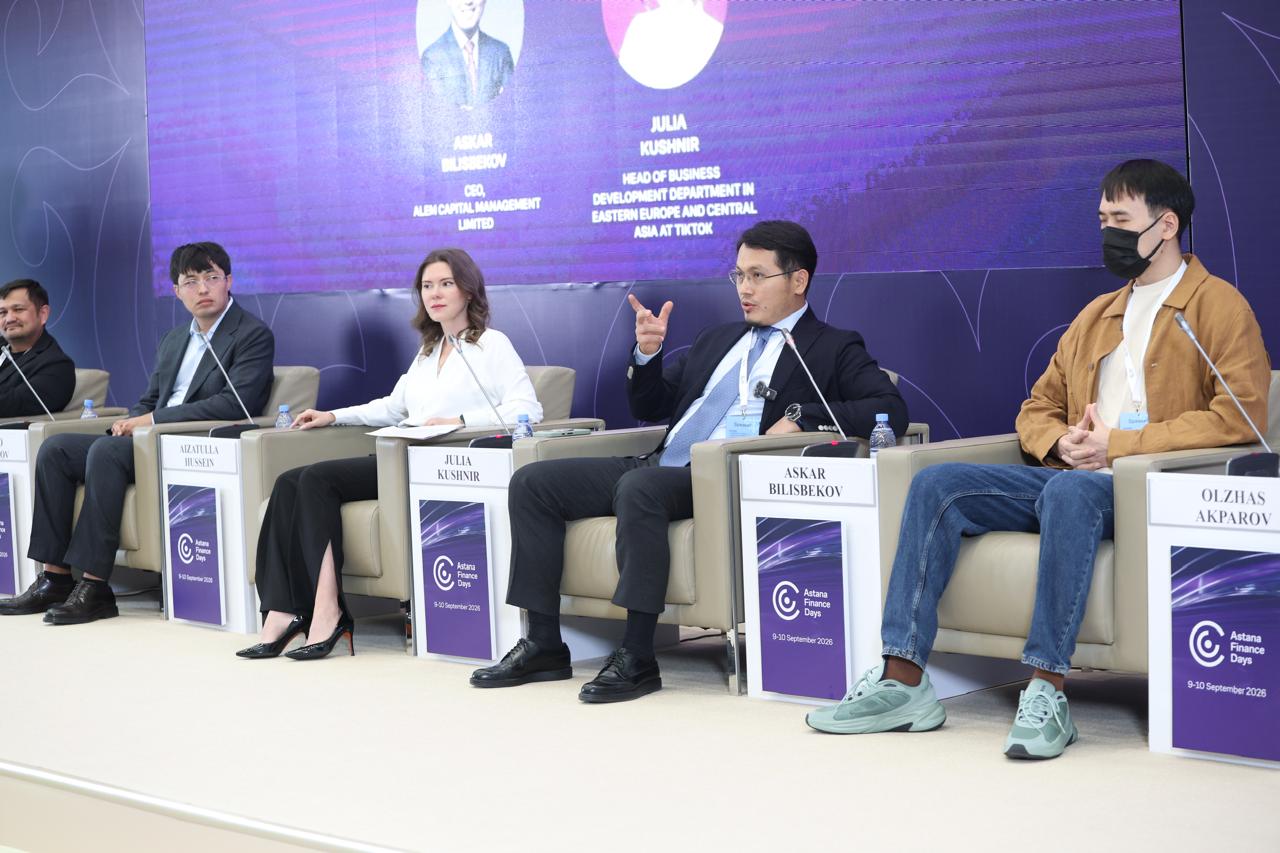
(From L to R) David Tuganov, president of the Creative Industries Alliance of Qazaqstan (CIAQ), the panel brought together Aizatulla Hussein, founder of Õzen; Olzhas Akparov, CBDO of Cyber Temple; Julia Kushnir, head of business development for Eastern Europe and Central Asia at TikTok; and Askar Bilisbekov, CEO of Alem Capital Management Limited. Photo credit: AFD 2026
The question was at the center of discussions on the second day of Astana Finance Days (AFD) 2026, held on Sept. 10 and dedicated to creative industries as an asset class. Moderated by David Tuganov, president of the Creative Industries Alliance of Qazaqstan (CIAQ), the panel brought together Aizatulla Hussein, founder of Õzen, Olzhas Akparov, CBDO of Cyber Temple, Julia Kushnir, head of business development for Eastern Europe and Central Asia at TikTok, and Askar Bilisbekov, CEO of Alem Capital Management Limited.
Tokenization of the song?
One of the clearest examples of that shift came from the music industry, where Õzen is working on what Hussein described as a new way to turn music intellectual property into a financial asset through blockchain-based tokenization.
Hussein described a new way to turn music intellectual property into a financial asset through blockchain-based tokenization. Photo credit: AFD 2026
“For the last seven years that we have been working in the music industry, our core business has been the distribution of music content in the digital space. But music is not simply entertainment. It is a full-fledged financial asset that can generate income over many years, and that income continues to grow,” Hussein said.
The concept is to tokenize music rights through smart contracts and allow investors to acquire a fractional economic interest in a song, with returns linked to the income generated by the underlying music.
“What we are doing now is tokenizing the music asset, the music intellectual property, through smart contracts. Now we give anyone the opportunity to come and buy a piece of this song, and when the income comes to the artist, proportionally to how many tokens they have acquired, they will receive those payments,” Hussein said.
The model, he said, could effectively create an internal marketplace for music, where investors can assess the performance and potential of individual compositions using data generated across digital platforms. Õzen’s model is still building the necessary legal and regulatory framework, with Hussein identifying jurisdiction as the key challenge rather than the technology itself.
“In principle, the technology is not a problem at all. These technologies have already been developed. The only serious thing that we need to implement correctly is the jurisdiction, how we can turn a contract into tokens,” he said, noting that the company hopes to launch pilot projects by the end of the year.
The move is significant because it changes the conversation around creative industries from one centered primarily on grants, promotion and audience growth to one centered on ownership, cash flows and investment returns.
Shift in investors’ mindset
Bilisbekov also emphasized this shift in investor thinking, noting that the main obstacle facing creative entrepreneurs in Kazakhstan is often not a lack of talent, but an insufficient understanding of how to present that talent as a business proposition.
Drawing a comparison with Hollywood’s film industry, he said investors have long understood that creative investments can be approached through venture capital strategies, where a number of projects are financed with the understanding that some will fail while a smaller number generate significant returns.
“In Hollywood, the principle was quite simple: invest in a large number of films, knowing and understanding that most of the films will fail,” Bilisbekov said.
He said similar venture-style approaches already finance creative projects globally, while Kazakhstan’s creative sector remains constrained by a fragmented market and a limited understanding of the investor relationship.
“In the creative industry in Kazakhstan and in our region, the attitude toward investors is always somewhat residual. Why? Because there is no understanding that an investor is, first of all, your partner,” he said.
For Bilisbekov, that means creative entrepreneurs also need to change how they themselves approach investment.
“We need to change our mindset,” he said, highlighting that creative founders must be able to understand the financial side of their businesses, communicate their models clearly and demonstrate that they can operate beyond the strength of an idea alone.
“One investor has never bought into a company simply because you are talented, simply because you have an idea,” he said.
From creativity to business value
The point is particularly relevant as the creative economy increasingly intersects with technology. TikTok, for example, is no longer simply a platform for entertainment, according to Kushnir, but part of Kazakhstan’s broader digital creative economy, giving creators, entrepreneurs and businesses direct access to audiences.
Hussein described a new way to turn music intellectual property into a financial asset through blockchain-based tokenization. Photo credit: AFD 2026
“The platform is part of Kazakhstan’s digital creative economy,” Kushnir said, emphasizing what she described as the democratization of creativity.
“Absolutely any person has all the tools and all the opportunities to interact with an audience,” she said, noting that creators do not necessarily need millions of followers or an established public profile to find an audience.
For businesses, that audience can translate into commercial value, with TikTok’s research with the Atameken National Chamber of Entrepreneurs showing that 80% of surveyed small and medium-sized businesses said the platform helps them attract new customers, 79% said it helps them retain customers, and around 70% said it helps them differentiate themselves from competitors. The next step, however, is converting reach and creativity into durable businesses and investable assets. That is where the convergence of creativity, technology and capital becomes particularly important.
Where AI meets creativity
Akparov described how artificial intelligence is already changing parts of game development, including early-stage concept work and the creation of visual references, while Bilisbekov said that Kazakhstan’s strongest competitive advantage may ultimately lie in its human capital.
“Our brains are absolutely competitive. There are simply a little bit more efforts needed in this direction. There will be more of these startups,” Bilisbekov said.
Hussein likewise pointed to a growing convergence between Kazakhstan’s technology and creative communities, arguing that the two sectors need to become less separate.
“IT people should come to creatives, and creatives should come to IT,” he said, describing them as two communities that have traditionally developed in parallel rather than together.
That convergence could become increasingly important as AI lowers some of the technical barriers to building digital products and puts greater value on ideas, storytelling, design and other forms of creative input.
For Kazakhstan, however, panelists suggested that the missing piece is still capital. Hussein noted that the country needs to create conditions for creative talent to develop into sustainable businesses, while Bilisbekov pointed to two priorities: dedicated programs for the creative industries and a deeper capital market.
“We don’t have, as far as I know, even a single acceleration program that has been launched for the creative industry. That is something that needs to be launched,” Bilisbekov said.
He also stressed the importance of developing Kazakhstan’s capital market more broadly, saying creative businesses need financing mechanisms that go beyond traditional business models.
“It is very important to develop the capital market. What we unfortunately lack today is exactly that,” he said.
That is perhaps the broader investment question emerging from Kazakhstan’s creative economy: not whether the country has talent, but whether it can build the financial, technological and regulatory infrastructure needed to turn that talent into assets that can be valued, financed and scaled.
The tokenization initiative being developed by Õzen offers one early example of what that could look like, moving music from a product consumed by an audience toward an asset in which an investor could potentially hold an economic interest.
For a country seeking to deepen its capital markets while developing a new generation of creative businesses, the shift may ultimately require both sides of the equation to rethink their roles: creatives need to become more financially literate, and investors need to become more comfortable assessing assets whose value may be built around intellectual property, audience, technology and cultural relevance rather than factories, equipment or conventional balance sheets.
