
ROME — The second week of the 2026 Winter Olympics in Milan-Cortina saw Kazakhstan add historic results in ski jumping, top-10 finishes in speed skating, and figure skating finals appearances as competition intensified across disciplines.
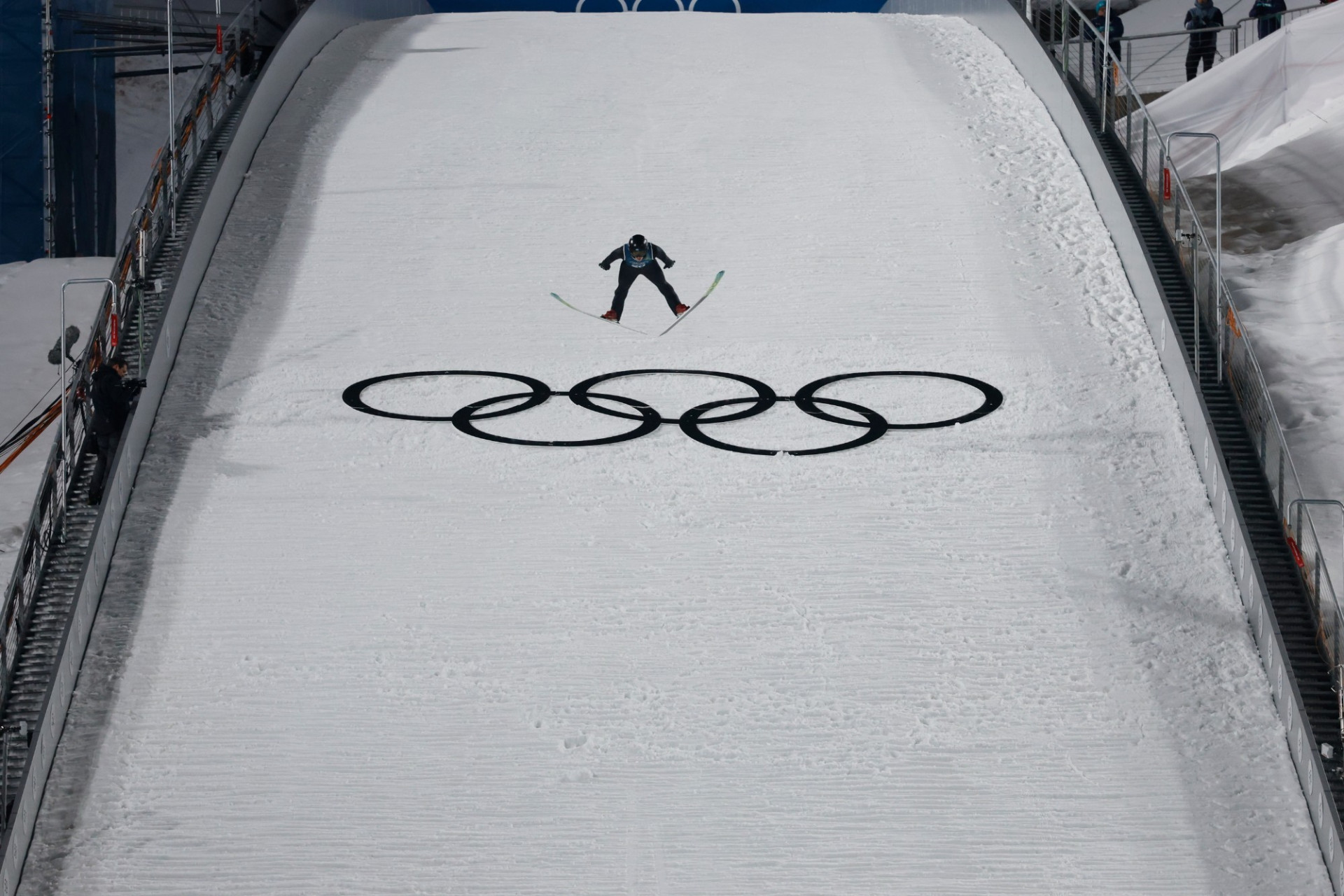
Kazakhstan’s olympic athlete in ski jumping Ilya Mizernykh. Photo credit: Turar Kazangapov / olympic.kz
The momentum followed a landmark opening week, when Mikhail Shaidorov secured Kazakhstan’s first Olympic title in figure skating and the country’s second Winter Olympic gold.
Moguls and relay performances
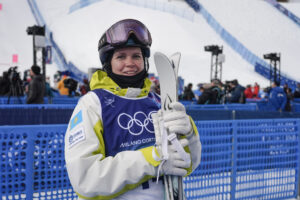
Kazakhstan’s mogul skier Yulia Galysheva. Photo credit: Turar Kazangapov. Photo credit: olympic.kz
Freestyle moguls opened the week’s schedule on Feb. 14. In women’s parallel moguls, Anastasia Gorodko advanced furthest, reaching the quarterfinals before a fall ended her run. Yulia Galysheva exited in the round of 16, while Ayaulym Amrenova concluded her performance in the opening round.
“In the final run, I made mistakes. You can only blame yourself. The main thing is that I avoided injury and stayed on the course. I am still satisfied with myself. My career has been rich. I have an Olympic medal [2018]. Yes, not gold, but winning bronze in individual moguls is valuable,” said Galysheva.
Galysheva finished 13th overall as the women’s moguls team wrapped up its Olympic campaign.
On the same day, in cross-country skiing, Ksenia Shalygina, Anna Melnik, Nadezhda Stepashkina and Darya Ryazhko placed 15th in the 4×7.5-kilometer relay.
Alpine skier Rostislav Khokhlov competed in giant slalom, where results are determined by the combined time of two runs, finishing 51st.
Speed skating, biathlon and ski jumping
Biathlon continued Feb. 14 with the women’s 7.5-kilometer sprint. Milana Geneva placed 88th with three misses, and Aisha Rakisheva finished 91st, concluding Kazakhstan’s women’s biathlon Olympic participation.
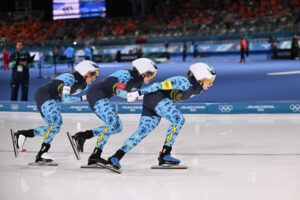
Kazakhstan’s speed skaters Nadezhda Morozova, Elizaveta Golubeva and Arina Ilyashenko. Photo credit: Sali Sabirov / olympic.kz
In speed skating, the women’s team pursuit ended prematurely after Nadezhda Morozova, Elizaveta Golubeva and Arina Ilyashenko fell during the quarterfinal. Kazakhstan was classified eighth and will compete in Final D for seventh place.
The following day, Yevgeny Koshkin raced in the men’s 500 meters, finishing ninth in 34.56 seconds, marking one of Kazakhstan’s strongest individual results of the week.
“If we look at the time, I’m not fully satisfied. I thought it would be faster. I felt excellent. Training went well. Maybe nerves played a role. I tried to execute everything as planned,” said Koshkin.
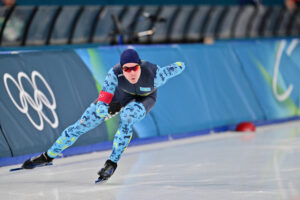
Kazakhstan’s speed skater Yevgeny Koshkin. Photo credit: Sali Sabirov / olympic.kz
In the women’s 500 meters, Kristina Silaeva placed 18th and Ilyashenko 29th.
The day was also marked by a historic ski jumping. Ilya Mizernykh finished eighth in the large hill final with 281.6 points, which is the best Olympic performance in the sport for Kazakhstan. Daniil Vasilev placed 27th.
“I am satisfied, but there is still a feeling inside that I could have fought for a medal. (…) But the result is a result. And this is only the beginning. I am not saying this only about myself, but about the entire Kazakhstan team,” said Mizernykh.
In the “super team” event, Mizernykh and Vasilev placed 11th. Weather conditions led to the cancellation of the final round, and results were confirmed based on earlier jumps.
Nordic combined athlete Chingiz Rakparov ranked 35th after the large hill jump and finished 32nd overall following the 10-kilometer cross-country segment on Feb. 17.
Short track and figure skating
Short-track events intensified in the men’s 500 meters on Feb. 16-18. Abzal Azhgaliyev advanced from the heats but did not move beyond the quarterfinals. Denis Nikisha progressed to the semifinals and ultimately placed seventh overall after finishing second in Final B on Feb. 18.
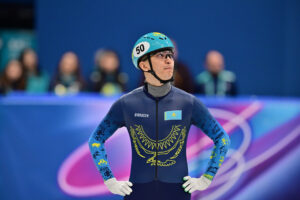
Kazakh short track speed skater Abzal Azhgaliyev. Photo credit: Sali Sabirov / olympic.kz
In the women’s 1,000 meters, Olga Tikhonova did not advance from qualification.
Figure skating remained a strong discipline for Kazakhstan. Sofia Samodelkina stood 12th after the short program in women’s singles and climbed to 10th overall following the free skate, setting a new personal best total score of 207.46.
“I showed my maximum at this stage. Everything I prepared, I delivered, and I am incredibly happy. The fans’ support has been amazing. Each time, I am more and more surprised. I have seen so many videos on social media of people flying in from Kazakhstan to support me with flags. My aunt and cousin even came from Germany just to watch and cheer for me. That really helps. You feel freer when people applaud you, when you feel that strength and energy,” said Samodelkina.
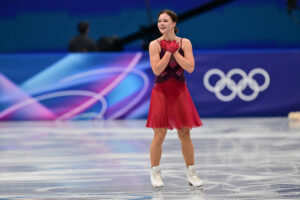
Kazakhstan’s figure skater Sofia Samodelkina. Photo credit: Sali Sabirov / olympic.kz
Freestyle aerials continued Feb. 20 with the men’s qualification round. Sherzod Khashirbaev, Dinmukhammed Raimkulov, Roman Ivanov and Asylkhan Asan represented Kazakhstan. To advance, athletes needed to place among the top 12 in each of the two qualification groups.
Ivanov delivered the team’s strongest result, scoring 105.75 points in his best attempt to finish 13th overall, just outside the final cutoff. Khashirbaev placed 16th with 98.67 points, Asan ranked 18th with 93.21, and Raimkulov finished 19th with 90.50. The Kazakh team did not progress to the final.
“Overall, everything was good. The weather did not interfere. We did everything we could. I would not say we performed poorly. We executed our elements cleanly and jumped at a good level. The field here includes the top 25 athletes in the world,” said Khashirbaev.
“We gave our full effort, but we did not show our very best result. Perhaps something was missing in our preparation. We are adapted to these weather conditions, so they were not an obstacle,” said Raimkulov.
“Ahead is work on our mistakes, analysis of the performance, and the goal to jump even better. At the next Olympics, we will aim to perform stronger,” he added.
Updated medal standings
As of Feb. 20, Norway leads the medal standings with 16 gold, eight silver and 10 bronze medals for 34. The United States ranks second with nine gold, 12 silver and six bronze for 27, while Italy sits third with nine gold, five silver and 12 bronze for 26.
